Helping Our Neighbors Stay Safe & Warm
Last Updated: Monday, January 26 at 1:00 p.m.
Winter storms can bring a lot of uncertainty, and we understand how stressful that can feel, especially when your family’s safety is on the line.
Please know that we are working diligently to serve as many customers as possible before the storm hits. Our goal is to help you stay safe, informed and comfortable.
This page shares:
Hall’s Delivery & Service Priorities
1. We Prioritize At-Risk Customers
During severe winter weather, we service the following situations first:
- No-heat situations
- Customers with critically low fuel levels* (10% or below) who rely on propane as their only heat source
- Safety-related concerns
- All other orders are reviewed for delivery as soon as conditions allow.
We truly wish we could reach everyone, but we must triage deliveries based on these criteria to focus on customers most at risk.
If your tank is between 30–50% full or greater, you likely have enough fuel to last through the storm and melt period. We appreciate your patience.
*Please note that inaccurate tank readings shared with Hall to ‘skip the line’ may result in a trip charge or discontinued service after this event. Help us help neighbors in true emergencies first.
2. Use Text & MyFuelPortal
During extreme weather events, our phone lines can become extremely busy.
Texting or using MyFuelPortal is the fastest way to communicate with us during the storm.
Text Your Local Office:
- Rocky Mount: (540) 590-7300
- Clemmons: (336) 766-9998
- Galax: (276) 236-5535
- Walnut Cove: (336) 591-4708
- Mt. Airy: (336) 415-4224
- Wytheville: (276) 236-5535
- Stuart: (276) 694-8585
- General Text Line: (336) 815-5050
Make sure to save the contact in your phone as “Hall Propane” so there is no confusion.
3. Be Ready for Delivery
To help us serve customers efficiently:
- Clear driveways and paths of snow or ice.
- Ensure your house number is visible and not buried in snow.
- If covered in snow, please mark the location of your underground propane tank with a flag or other marker.
- Make sure our truck has clear access to your tank with any obstacles removed. Our delivery hoses are about 120 feet long, so please make sure we can access your tank within that range. When possible, clear a path to the tank.
If your driveway is not cleared or your tank is not accessible, our team will not be able to make a delivery. We encourage you to make arrangements ahead of time with a snow removal professional, neighbors, friends or family if you need help! *Many landscaping services provide driveway snow clearing for a fee.
What To Do If You Lose Power or Heat
Should you experience a loss of heat during a winter storm, these simple steps can help keep you and your family safer and more comfortable.
- Stay in the warmest, most insulated room of your home.
- Use heavy blankets, sleeping bags and layered clothing to retain body heat.
- Avoid using stoves or ovens to heat your home.
- Use space heaters only if they have automatic shut-off switches, are placed away from flammables and are never left unattended.
- Cover large or drafty windows with a blanket, especially at night.
- Open the shade on sun facing windows in the daytime to allow sunlight in.
If you have a fireplace or wood stove, ensure proper ventilation and a working carbon monoxide detector.
For more winter weather safety resources, visit Ready.gov’s winter storm safety guides.
Prepare for Winter Weather
Pre-Storm Safety Checklist
- Stock at least one gallon of water per day for every person in your home for several days.
- Keep phones charged and have backup chargers or power banks available.
- Have flashlights and fresh batteries accessible.
- Monitor your fuel levels regularly and plan to conserve heat if needed.
- Insulate your home where possible. Close off unused rooms, seal drafts and use curtains or blankets to retain heat.
- If freezing pipes are a concern, consider leaving your water dripping or leaving cabinet doors open so warm air reaches the pipes.
- Install and test smoke and carbon monoxide detectors with battery backups before using alternate heat sources.
- Prepare a supply of non-perishable food and any medications you need.
- Bring pets indoors or ensure they have warm shelter, food and water.
- Plan to check on your family, friends and neighbors. Help the older population, who may be less able to prepare for the storm.
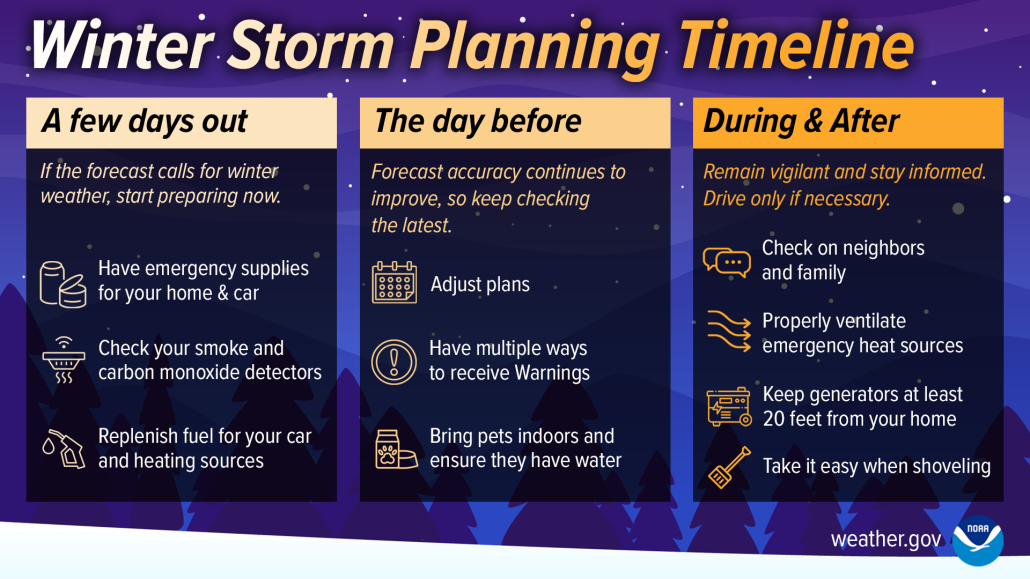
Source: National Weather Service. (n.d.). Winter weather safety. U.S. Department of Commerce. Retrieved January 21, 2026, from https://www.weather.gov/safety/winter
Hall gathered these safety tips from the following trusted sources: